
VPS Performance Trends We’re Seeing in 2026
2026 trends
insights
ServerVerify
The VPS industry continues evolving rapidly, and the benchmark data flowing into ServerVerify is revealing some very clear trends across modern hosting infrastructure. From AMD EPYC dominating benchmark leaderboards to the growing importance of storage consistency and regional competition, today’s VPS market looks very different than it did just a few years ago.
Here are some of the biggest VPS performance trends we’re seeing in 2026 based on real-world benchmark submissions and analytics data from ServerVerify.
AMD EPYC Is Dominating the Top of the Leaderboards
One of the clearest trends visible on ServerVerify is the continued dominance of AMD EPYC across high-performing VPS environments.
Looking at the current VPS leaderboard rankings, many of the top-scoring systems are powered by:
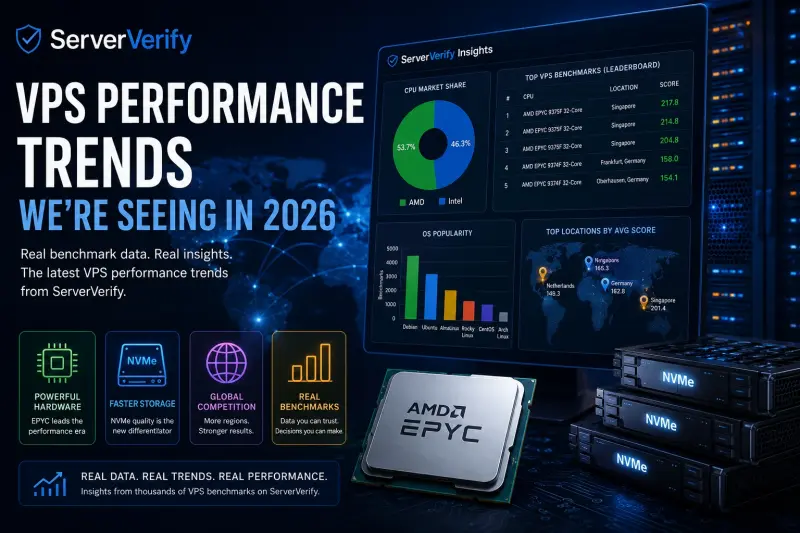
Meanwhile, the CPU Market Share section on the Insights page now shows AMD slightly ahead of Intel across benchmark submissions on the platform, something that would have seemed unlikely just a few years ago.
While Intel Xeon remains extremely common throughout enterprise infrastructure, the leaderboard data clearly shows AMD setting the pace for raw VPS performance in many modern deployments.
High Frequency CPUs Are Winning
Another major trend visible in the leaderboard data is the rise of high-frequency CPUs. Providers are no longer focusing purely on core density. Instead, many are prioritizing CPUs that balance strong clock speeds with high virtualization capacity.
This is especially visible with EPYC “F” series processors, which consistently appear near the top of the ServerVerify rankings.
These systems perform particularly well in:
NVMe Quality Is Becoming a Major Differentiator
The Insights data also reflects how storage performance has become one of the biggest differences between VPS providers.
A few years ago, simply advertising NVMe storage was enough to stand out. In 2026, benchmark submissions show enormous variation between providers depending on:
The benchmark variance between providers has made storage quality one of the most important performance differentiators on the platform.
Singapore and Germany Continue Producing Elite Results
Geographically, several regions continue dominating the leaderboard rankings. Singapore remains one of the strongest-performing VPS markets on ServerVerify, particularly among providers deploying modern EPYC infrastructure.
Germany also continues producing consistently strong benchmark results across both VPS and dedicated server categories.
According to benchmark activity visible across the Insights page and leaderboard data, other fast-growing high-performance regions include:
Overselling Is Still Easy to Spot
Despite major improvements across the industry, overselling remains highly visible in benchmark submissions.
Common warning signs seen in lower-performing benchmark results include:
Providers consistently appearing near the top of the leaderboards typically maintain lower virtualization density and better infrastructure discipline overall.
Linux Continues to Completely Dominate VPS Deployments
The Operating System section of ServerVerify Insights continues showing overwhelming Linux dominance across benchmark submissions.
The most common operating systems currently benchmarked on the platform include:
Transparency Is Becoming a Competitive Advantage
Another trend becoming increasingly obvious is the growing importance of infrastructure transparency.
Users are paying much closer attention to measurable benchmark data instead of relying solely on provider marketing claims.
Providers actively participating in:
Conclusion
The 2026 VPS market is faster, more competitive, and more performance-focused than ever before.
ServerVerify benchmark and Insights data clearly show several major trends shaping the industry:
Here are some of the biggest VPS performance trends we’re seeing in 2026 based on real-world benchmark submissions and analytics data from ServerVerify.
AMD EPYC Is Dominating the Top of the Leaderboards
One of the clearest trends visible on ServerVerify is the continued dominance of AMD EPYC across high-performing VPS environments.
Looking at the current VPS leaderboard rankings, many of the top-scoring systems are powered by:
- EPYC 9375F
- EPYC 9374F
- EPYC Genoa platforms
- EPYC 9754 deployments
Meanwhile, the CPU Market Share section on the Insights page now shows AMD slightly ahead of Intel across benchmark submissions on the platform, something that would have seemed unlikely just a few years ago.
While Intel Xeon remains extremely common throughout enterprise infrastructure, the leaderboard data clearly shows AMD setting the pace for raw VPS performance in many modern deployments.
High Frequency CPUs Are Winning
Another major trend visible in the leaderboard data is the rise of high-frequency CPUs. Providers are no longer focusing purely on core density. Instead, many are prioritizing CPUs that balance strong clock speeds with high virtualization capacity.
This is especially visible with EPYC “F” series processors, which consistently appear near the top of the ServerVerify rankings.
These systems perform particularly well in:
- Web hosting
- Databases
- Game servers
- Build systems
- Low-latency workloads
NVMe Quality Is Becoming a Major Differentiator
The Insights data also reflects how storage performance has become one of the biggest differences between VPS providers.
A few years ago, simply advertising NVMe storage was enough to stand out. In 2026, benchmark submissions show enormous variation between providers depending on:
- PCIe generation
- RAID architecture
- Storage oversubscription
- Local vs network-backed storage
- I/O consistency under sustained load
The benchmark variance between providers has made storage quality one of the most important performance differentiators on the platform.
Singapore and Germany Continue Producing Elite Results
Geographically, several regions continue dominating the leaderboard rankings. Singapore remains one of the strongest-performing VPS markets on ServerVerify, particularly among providers deploying modern EPYC infrastructure.
Germany also continues producing consistently strong benchmark results across both VPS and dedicated server categories.
According to benchmark activity visible across the Insights page and leaderboard data, other fast-growing high-performance regions include:
- Netherlands
- Romania
- Poland
- Austria
- United States
Overselling Is Still Easy to Spot
Despite major improvements across the industry, overselling remains highly visible in benchmark submissions.
Common warning signs seen in lower-performing benchmark results include:
- Inconsistent CPU scores
- Large benchmark variance between identical plans
- High storage latency
- Weak sustained load performance
Providers consistently appearing near the top of the leaderboards typically maintain lower virtualization density and better infrastructure discipline overall.
Linux Continues to Completely Dominate VPS Deployments
The Operating System section of ServerVerify Insights continues showing overwhelming Linux dominance across benchmark submissions.
The most common operating systems currently benchmarked on the platform include:
- Debian
- Ubuntu
- AlmaLinux
- Rocky Linux
Transparency Is Becoming a Competitive Advantage
Another trend becoming increasingly obvious is the growing importance of infrastructure transparency.
Users are paying much closer attention to measurable benchmark data instead of relying solely on provider marketing claims.
Providers actively participating in:
- Benchmark submissions
- Public leaderboard rankings
- Reviews
- Infrastructure transparency
Conclusion
The 2026 VPS market is faster, more competitive, and more performance-focused than ever before.
ServerVerify benchmark and Insights data clearly show several major trends shaping the industry:
- AMD EPYC dominating high-performance VPS deployments
- High-frequency CPUs becoming increasingly important
- Storage quality mattering more than ever
- Global infrastructure competition accelerating
- Benchmark transparency becoming a key differentiator

About the Author
Jon Biloh
Jon Biloh is the founder of ColoCrossing, a global hosting and data center infrastructure company he started in 2006 and later sold to Deluxe Corporation in 2018. He has more than two decades of experience in the web hosting, dedicated server, VPS, colocation, and data center industries.
Jon owns and operates ServerVerify, as well as LowEndBox and LowEndTalk, two long-running communities focused on affordable hosting, VPS providers, and infrastructure trends. Through his work across hosting operations, data center strategy, and industry publishing, Jon writes about practical infrastructure decisions, hosting market dynamics, provider accountability, and the evolving needs of businesses that rely on reliable server platforms.
Jon owns and operates ServerVerify, as well as LowEndBox and LowEndTalk, two long-running communities focused on affordable hosting, VPS providers, and infrastructure trends. Through his work across hosting operations, data center strategy, and industry publishing, Jon writes about practical infrastructure decisions, hosting market dynamics, provider accountability, and the evolving needs of businesses that rely on reliable server platforms.