
AMD EPYC vs Intel Xeon for VPS Hosting: What ServerVerify Benchmark Data Actually Shows
insights
intel vs. amd
intel
amd
For years, Intel Xeon dominated the VPS hosting industry almost uncontested. That is no longer the case.
Based on benchmark and analytics data collected across ServerVerify, AMD EPYC has become the clear performance leader across much of today’s VPS market, particularly in newer high-performance virtualization environments.
While Intel still maintains a large footprint across enterprise infrastructure, the real-world benchmark data now strongly favors EPYC in many hosting deployments.
ServerVerify Insights Shows AMD Now Leading CPU Market Share
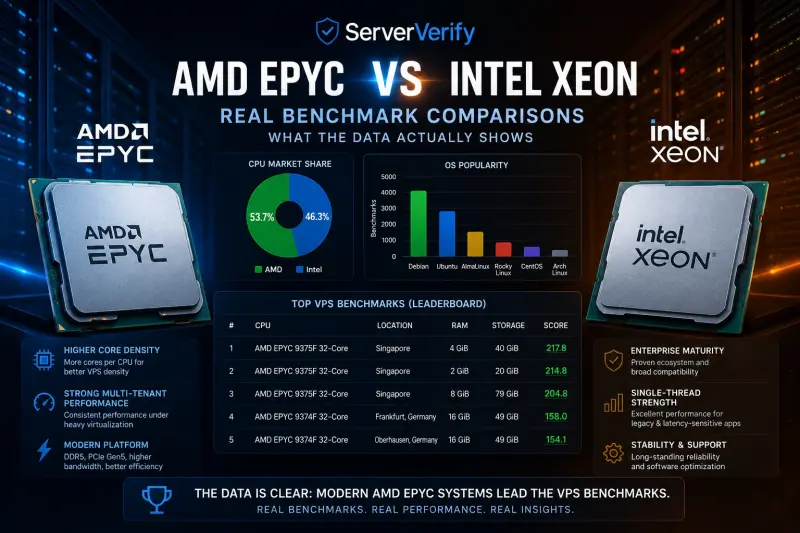
According to the CPU Market Share data available on the ServerVerify Insights page, AMD systems now slightly outnumber Intel systems across benchmark submissions on the platform.
That shift is significant.
For nearly two decades, Intel Xeon was effectively the default platform for VPS hosting. The fact that AMD has overtaken Intel in benchmark activity reflects how aggressively providers have adopted EPYC over the last several years.
The growth is especially concentrated among newer VPS deployments using:
The Leaderboards Heavily Favor EPYC Systems
The strongest evidence comes directly from the ServerVerify Leaderboards. Looking at the highest-scoring VPS benchmark results, EPYC systems dominate the upper portion of the rankings.
Current leaderboard leaders include:
CPU | Location | Score
AMD EPYC 9375F 32-Core | Singapore | 217.8
AMD EPYC 9375F 32-Core | Singapore | 214.8
AMD EPYC 9375F 32-Core | Singapore | 204.8
AMD EPYC 9374F 32-Core | Germany | 158.0
AMD EPYC 9374F 32-Core | Germany | 154.1
The gap is not small.
Many of the highest-performing VPS systems on ServerVerify are clustered around modern EPYC platforms, particularly the higher-frequency “F” series processors optimized for performance-sensitive workloads.
Intel systems do still appear throughout the rankings, but far less frequently at the very top.
Why EPYC Is Performing Better in VPS Environments
The ServerVerify data aligns closely with what many providers have already observed operationally.
Modern VPS infrastructure benefits heavily from:
The Importance of Cache and Core Architecture
One major advantage for EPYC in virtualization is cache availability.
High-density VPS nodes create heavy shared-cache pressure. EPYC’s large L3 cache architecture significantly improves performance consistency under virtualization compared to many older Xeon platforms.
This becomes particularly noticeable in:
EPYC “F” Series CPUs Are Dominating Premium VPS Nodes
One particularly interesting trend from the leaderboard data is how frequently EPYC “F” series CPUs appear at the top.
Processors like the EPYC 9375F prioritize higher clock speeds while still maintaining strong core counts, making them extremely attractive for VPS hosting.
Providers deploying these systems are consistently producing benchmark scores well above older Xeon-based environments.
The current top leaderboard entries are almost entirely dominated by these newer EPYC configurations.
Intel Xeon Still Has Strengths
This does not mean Intel is irrelevant.
Intel still performs well in several areas:
However, based on the current ServerVerify dataset, Intel is no longer setting the pace in VPS hosting performance.
AMD is.
Geography Trends Also Support EPYC Adoption
Another interesting pattern visible in the leaderboard data is where these high-performing systems are located.
Many of the strongest EPYC benchmark results are coming from:
Linux Dominates Across Both Platforms
The Insights page also shows Linux overwhelmingly dominating deployments across both AMD and Intel systems.
The most common operating systems benchmarked on ServerVerify include:
The Most Important Takeaway: Real Data Matters
Perhaps the biggest conclusion from the ServerVerify dataset is this: CPU branding alone is not enough.
A poorly configured EPYC node can still perform badly. A well-managed Xeon node with low contention and strong NVMe storage can still outperform lower-quality competitors. But when looking broadly across hundreds of benchmark submissions and leaderboard rankings, the data clearly shows where the industry is moving.
Modern EPYC deployments are consistently producing stronger benchmark results across VPS hosting environments.
Conclusion
The ServerVerify benchmark and Insights data paints a very clear picture of the current VPS hosting landscape.
Intel Xeon remains an important and capable platform, particularly across legacy enterprise infrastructure and mature virtualization environments.
But in terms of raw VPS benchmark performance, modern AMD EPYC systems are increasingly dominating the market.
The combination of:
And according to the real-world ServerVerify leaderboard data, that advantage is no longer theoretical. It is measurable.
Based on benchmark and analytics data collected across ServerVerify, AMD EPYC has become the clear performance leader across much of today’s VPS market, particularly in newer high-performance virtualization environments.
While Intel still maintains a large footprint across enterprise infrastructure, the real-world benchmark data now strongly favors EPYC in many hosting deployments.
ServerVerify Insights Shows AMD Now Leading CPU Market Share
According to the CPU Market Share data available on the ServerVerify Insights page, AMD systems now slightly outnumber Intel systems across benchmark submissions on the platform.
That shift is significant.
For nearly two decades, Intel Xeon was effectively the default platform for VPS hosting. The fact that AMD has overtaken Intel in benchmark activity reflects how aggressively providers have adopted EPYC over the last several years.
The growth is especially concentrated among newer VPS deployments using:
- EPYC 9354
- EPYC 9374F
- EPYC 9375F
- EPYC Genoa platforms
- EPYC 9754 high-density systems
The Leaderboards Heavily Favor EPYC Systems
The strongest evidence comes directly from the ServerVerify Leaderboards. Looking at the highest-scoring VPS benchmark results, EPYC systems dominate the upper portion of the rankings.
Current leaderboard leaders include:
CPU | Location | Score
AMD EPYC 9375F 32-Core | Singapore | 217.8
AMD EPYC 9375F 32-Core | Singapore | 214.8
AMD EPYC 9375F 32-Core | Singapore | 204.8
AMD EPYC 9374F 32-Core | Germany | 158.0
AMD EPYC 9374F 32-Core | Germany | 154.1
The gap is not small.
Many of the highest-performing VPS systems on ServerVerify are clustered around modern EPYC platforms, particularly the higher-frequency “F” series processors optimized for performance-sensitive workloads.
Intel systems do still appear throughout the rankings, but far less frequently at the very top.
Why EPYC Is Performing Better in VPS Environments
The ServerVerify data aligns closely with what many providers have already observed operationally.
Modern VPS infrastructure benefits heavily from:
- High core density
- Large L3 cache pools
- Memory bandwidth
- Strong virtualization scheduling efficiency
- Power efficiency under sustained multi-tenant load
The Importance of Cache and Core Architecture
One major advantage for EPYC in virtualization is cache availability.
High-density VPS nodes create heavy shared-cache pressure. EPYC’s large L3 cache architecture significantly improves performance consistency under virtualization compared to many older Xeon platforms.
This becomes particularly noticeable in:
- Database workloads
- Web hosting clusters
- Containerized environments
- Build systems
- Multi-tenant VPS nodes
EPYC “F” Series CPUs Are Dominating Premium VPS Nodes
One particularly interesting trend from the leaderboard data is how frequently EPYC “F” series CPUs appear at the top.
Processors like the EPYC 9375F prioritize higher clock speeds while still maintaining strong core counts, making them extremely attractive for VPS hosting.
Providers deploying these systems are consistently producing benchmark scores well above older Xeon-based environments.
The current top leaderboard entries are almost entirely dominated by these newer EPYC configurations.
Intel Xeon Still Has Strengths
This does not mean Intel is irrelevant.
Intel still performs well in several areas:
- Mature enterprise ecosystems
- Strong single-thread performance
- Broad software optimization
- Stable virtualization tooling
- Long-standing enterprise deployment history
However, based on the current ServerVerify dataset, Intel is no longer setting the pace in VPS hosting performance.
AMD is.
Geography Trends Also Support EPYC Adoption
Another interesting pattern visible in the leaderboard data is where these high-performing systems are located.
Many of the strongest EPYC benchmark results are coming from:
- Singapore
- Germany
- Netherlands
- Eastern Europe
- Modern US cloud deployments
Linux Dominates Across Both Platforms
The Insights page also shows Linux overwhelmingly dominating deployments across both AMD and Intel systems.
The most common operating systems benchmarked on ServerVerify include:
- Debian
- Ubuntu
- AlmaLinux
- Rocky Linux
The Most Important Takeaway: Real Data Matters
Perhaps the biggest conclusion from the ServerVerify dataset is this: CPU branding alone is not enough.
A poorly configured EPYC node can still perform badly. A well-managed Xeon node with low contention and strong NVMe storage can still outperform lower-quality competitors. But when looking broadly across hundreds of benchmark submissions and leaderboard rankings, the data clearly shows where the industry is moving.
Modern EPYC deployments are consistently producing stronger benchmark results across VPS hosting environments.
Conclusion
The ServerVerify benchmark and Insights data paints a very clear picture of the current VPS hosting landscape.
Intel Xeon remains an important and capable platform, particularly across legacy enterprise infrastructure and mature virtualization environments.
But in terms of raw VPS benchmark performance, modern AMD EPYC systems are increasingly dominating the market.
The combination of:
- Higher core density
- Larger cache pools
- Better virtualization efficiency
- Stronger multi-tenant performance
- Modern platform architecture
And according to the real-world ServerVerify leaderboard data, that advantage is no longer theoretical. It is measurable.

About the Author
Jon Biloh
Jon Biloh is the founder of ColoCrossing, a global hosting and data center infrastructure company he started in 2006 and later sold to Deluxe Corporation in 2018. He has more than two decades of experience in the web hosting, dedicated server, VPS, colocation, and data center industries.
Jon owns and operates ServerVerify, as well as LowEndBox and LowEndTalk, two long-running communities focused on affordable hosting, VPS providers, and infrastructure trends. Through his work across hosting operations, data center strategy, and industry publishing, Jon writes about practical infrastructure decisions, hosting market dynamics, provider accountability, and the evolving needs of businesses that rely on reliable server platforms.
Jon owns and operates ServerVerify, as well as LowEndBox and LowEndTalk, two long-running communities focused on affordable hosting, VPS providers, and infrastructure trends. Through his work across hosting operations, data center strategy, and industry publishing, Jon writes about practical infrastructure decisions, hosting market dynamics, provider accountability, and the evolving needs of businesses that rely on reliable server platforms.